How should a housing society plan shared EV chargers?
Start with resident demand, parking permissions and available electrical capacity. Agree on access, usage measurement, payment responsibility and maintenance before selecting chargers. A phased deployment can suit uncertain demand better than installing a large number of high-powered units immediately.
Agree on ownership and access
Shared parking creates questions that a standalone household installation does not. Identify whether spaces are assigned or common, who may use each charger and who has permission to install equipment. Obtain the relevant approvals before spending on hardware or permanent cabling.
Decide who owns the chargers and pays for the electrical work: the society, individual residents or an operator. Record the arrangement and what happens when a resident moves out or changes vehicles. A clear agreement is more useful than a charger that no one is authorised to maintain.
Survey demand and spare capacity
Collect current EV counts, vehicle types, typical arrival times and expected charging duration. Cars parked overnight may not need the same power as fleet vehicles turning around quickly. Do not select DC fast charging only because its label sounds more advanced; cost, compatibility and site supply are important constraints.
Ask the electrical team to assess the connection, distribution system and potential simultaneous charging demand. Load management may help coordinate chargers within a defined limit, but it does not replace adequate protection or authorised supply capacity. Plan cable routes so they do not obstruct walkways, exits or routine parking operations.
Write down a fair operating model
Residents need to know how use is recorded and paid for. Define access controls, booking rules, session limits, payment responsibility and the process for a failed session. Confirm whether the chosen equipment and software support the actual billing method rather than assuming every charger includes an app and complete reporting.
Maintenance needs an owner, a contact and a budget. Set procedures for reporting damaged equipment and managing a charger that is out of service. The Ministry of Power guidelines cover charging in group housing and other semi-restricted settings; consult the applicable current requirements with your installer and electricity utility.
- Resident demand and vehicle compatibility
- Parking rights and written society approval
- Supply capacity and phased expansion
- Usage recording and payment responsibility
- Cable management and safe access
- Maintenance owner and escalation process
Keep a future solar project separate but coordinated
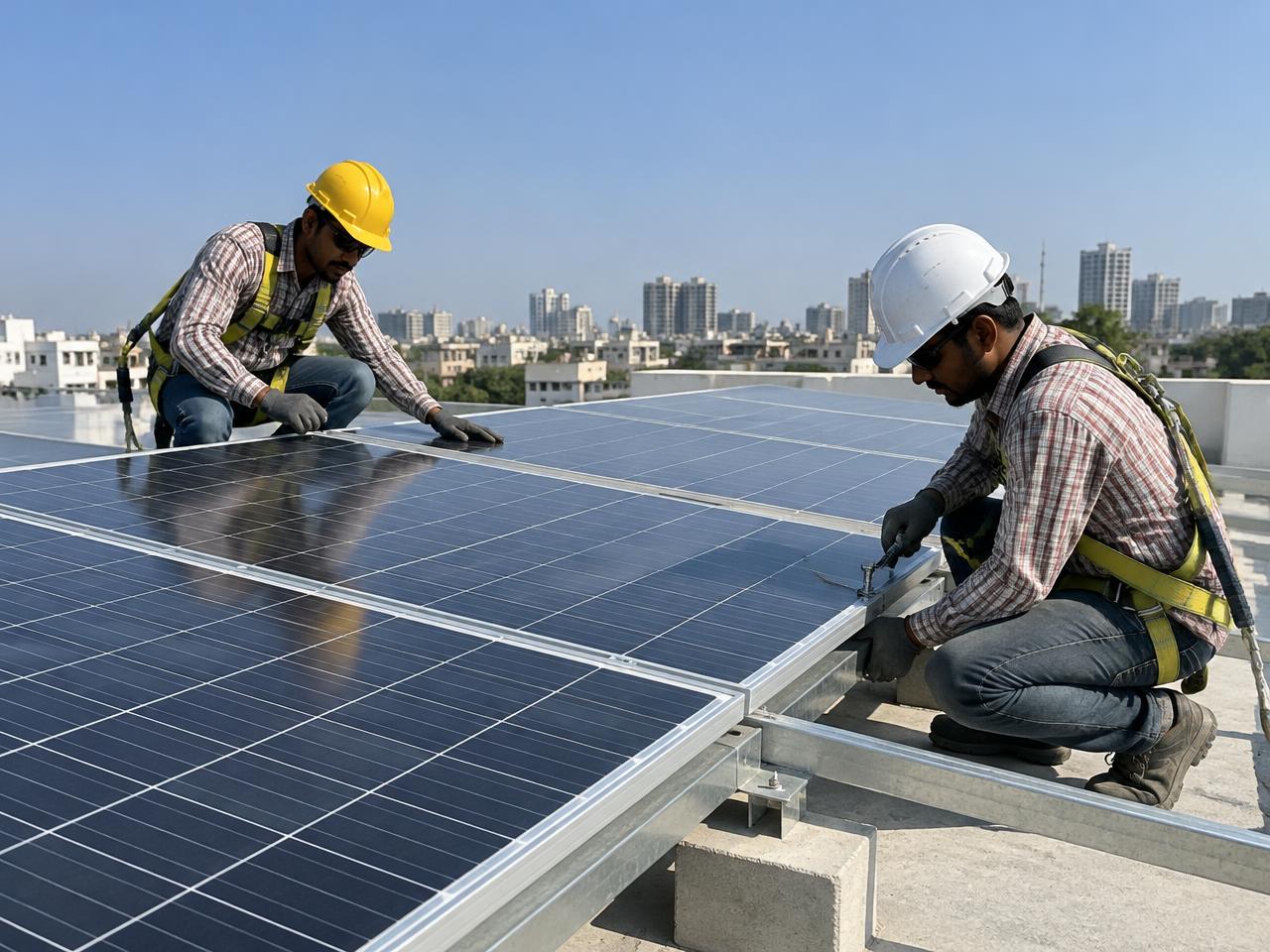
A society may also assess rooftop solar for common loads or charging. That requires its own roof, generation and metering design; simply placing panels on the building does not prove that each charging session uses solar. Residential household subsidy examples are not automatically the correct formula for a society’s common installation.
Your questions, answered
Should every parking bay get a charger now?
Not necessarily. Match the first phase to real demand while planning cable routes and electrical infrastructure for future expansion.
Can rooftop solar support shared charging?
Potentially, with an appropriate electrical and metering design. Generation timing, common-load demand and approvals need assessment.
Sources & further reading
- Ministry of Power — EV charging infrastructure guidelines, 2024
- MNRE — PM Surya Ghar residential financial assistance guidelines
- UPNEDA — residential rooftop solar resources and application procedure
General purchase guidance. Check current official rules, manufacturer instructions and your written quotation before proceeding. Images are illustrative, not documented Silex installations or verified model photographs.